

Entering
Is a paid BFSI programme worth it when free courses exist on YouTube?
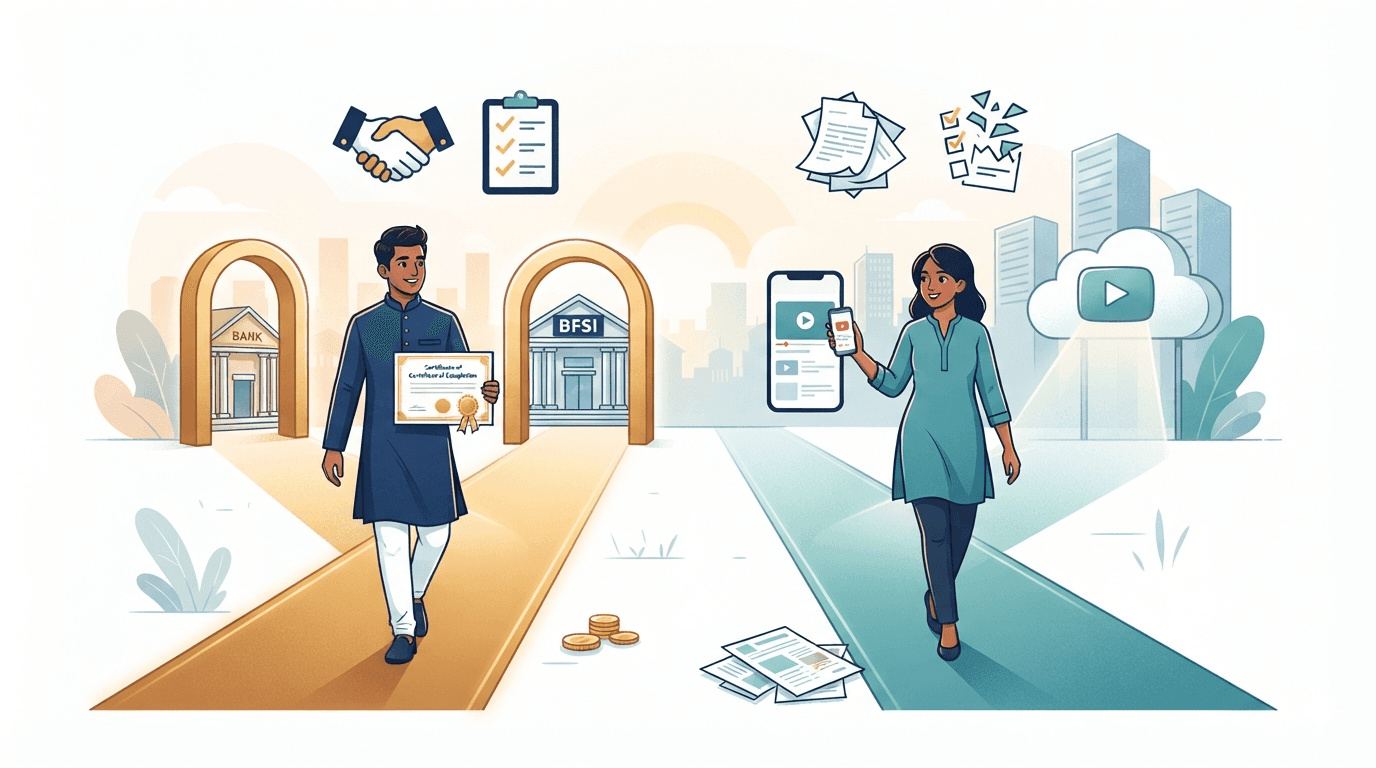
Short answer: yes, if the paid programme gets you three things YouTube can't — a structured path, verified skills, and a door into an employer's shortlist. If it's just re-packaging what's already free online, skip it.
Here's the honest breakdown.
What YouTube is genuinely good for
YouTube is excellent for concepts — understanding what KYC means, how a mutual fund NAV is calculated, or what a credit officer actually does day to day. If you're curious and want to test whether BFSI interests you before committing money, watch videos first. It costs nothing and it's not a bad way to build vocabulary.
Where it falls apart
Three things break down once you actually try to get hired on YouTube learning alone:
- No sequence. A 20-minute video on "banking basics" and another on "insurance sales" don't add up to a curriculum. You end up with scattered facts, not a skill an interviewer can verify.
- No proof. Recruiters in BFSI — banks, NBFCs, insurance companies — screen resumes fast. "I watched YouTube videos on banking" doesn't clear that filter. A recognised certificate, especially one tied to a known training provider or aligned to IRDAI/NISM-style content, does.
- No placement pipeline. This is the real gap. Free content teaches you the subject. It does nothing to get your resume in front of a hiring manager, prep you for a specific interview format (like a bank's group discussion round or an insurance advisor's sales pitch simulation), or connect you to a recruiter who's actually hiring this month.
What you're actually paying for
When a BFSI training programme is worth its fee, you're paying for:
- A structured curriculum that maps to what employers in retail banking, insurance advisory, or NBFC roles actually test candidates on.
- Practical assessment — mock interviews, role-plays, case studies — not just lecture videos.
- Placement support — resume screening, interview scheduling, and in some cases direct tie-ups with hiring companies.
- Accountability — a cohort and deadlines. Free content has a 90%+ drop-off rate because nothing forces you to finish. A paid, cohort-based programme has attendance and completion pressure built in.
How to tell if a paid programme is worth it — before you pay
Ask the provider three questions:
- What's your placement record for the last batch? Ask for numbers, not adjectives. "Many of our students got placed" is not an answer — a placement percentage and company names are.
- Who teaches this — practitioners or generic trainers? Someone who's actually worked in retail banking or insurance sales teaches differently than someone reading off slides.
- What happens after the course ends? If the answer is "nothing," you've paid for content you could have found free. If there's continued placement assistance, that's the actual value.
Bottom line
Use YouTube to explore whether BFSI is for you. Use a paid programme once you've decided to commit — but only one with a real placement track record and hands-on assessment, not just more lecture content in a paid wrapper. The fee should be buying you a job outcome, not information you already have access to for free.
Related questions
How much does a good BFSI certification course cost in India?
Most reputable BFSI training programmes in India range from a few thousand to around Rs. 25,000-40,000 depending on depth and placement support included. Programmes bundled with guaranteed interview opportunities or NISM/IRDAI-aligned certification tend to sit at the higher end. Always weigh the fee against the placement track record, not just the syllabus.
Can I get a BFSI job with only free online courses and no certification?
It's possible but harder — you'll need to prove your knowledge some other way, such as through a strong interview performance or a referral. Most recruiters use certifications as a fast first filter, so without one you're relying entirely on getting an interview to demonstrate what you know.
What should I check before enrolling in any paid training programme?
Verify the trainer's real industry experience, ask for actual placement percentages and company names from recent batches, and confirm whether placement support continues after the course ends. Avoid providers who can't share concrete outcomes when asked directly.
Keep reading
Is BFSI training worth it? Are lateral-entry, diploma-to-degree and distance graduates eligible for bank jobs? Is insurance advisory a real career, or just commission work?Want a structured path into a BFSI role?
See the program built for candidates making exactly this move — a live-online or classroom certification, with a dedicated placement drive.