

Entering
IBPS and SBI exams or a private bank job — which route gets you employed faster?
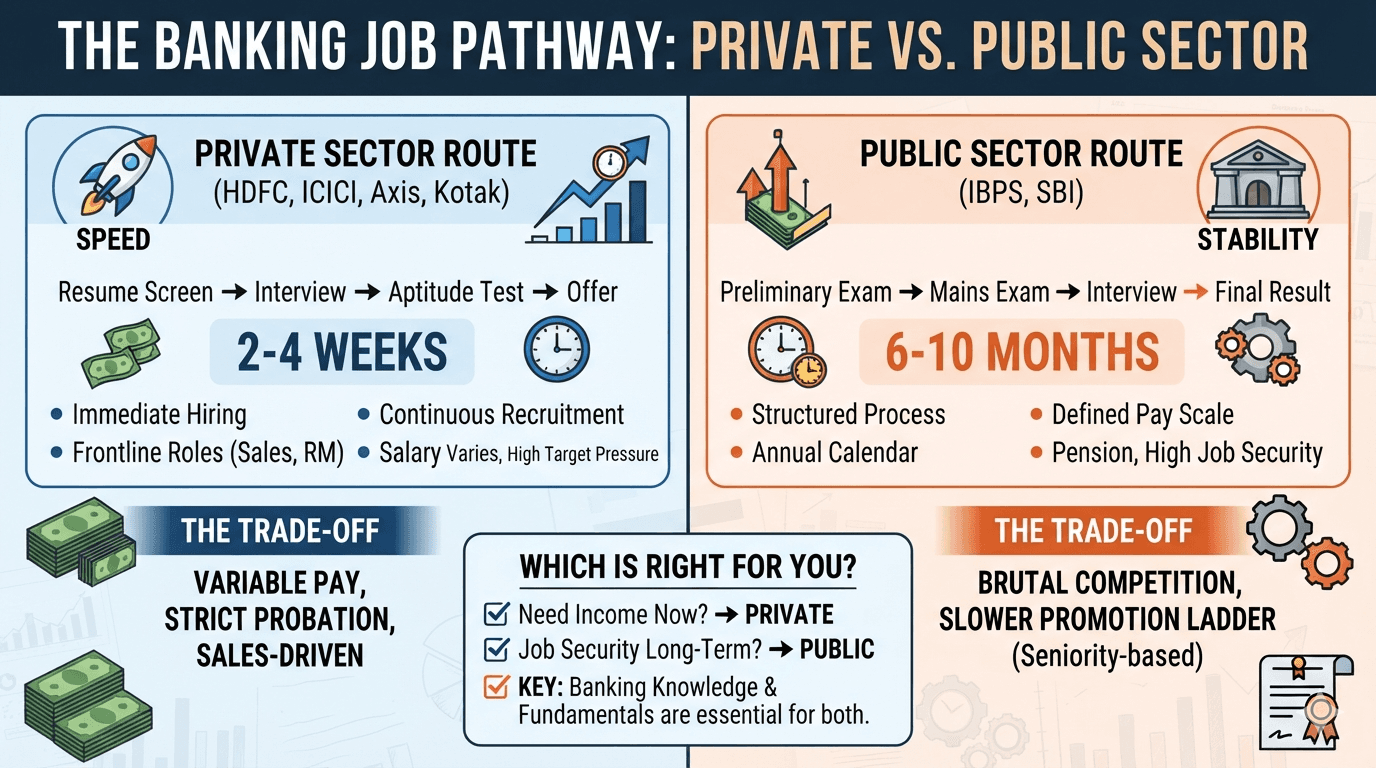
If speed is genuinely your only criterion, a private bank job wins. You can walk into an HDFC, ICICI, Axis, or Kotak hiring drive, clear an interview and a basic aptitude round, and be on payroll within 2-4 weeks. IBPS and SBI recruitment, by contrast, runs on an annual calendar that stretches 6-10 months from notification to joining, with two or three exam stages in between.
But "faster" and "better for you" aren't the same question, so here's the real comparison.
Why private banks hire faster
Private banks recruit continuously, not once a year. Branches are always short-staffed for frontline roles — relationship officer, sales executive, personal banker, credit associate — so the hiring loop is short: a resume screen, one or two interviews, sometimes a role-play or aptitude test, then an offer. There's no centralized exam, no waiting for a result to be published, no separate interview call months later. If you're job-ready now and need income now, this is the faster door.
The trade-off is variability. Pay, work hours, and target pressure differ a lot by bank and role — a sales-heavy frontline position can mean aggressive monthly targets, while a back-office or operations role is calmer but pays less. You're also more exposed during probation; private banks let go of underperformers faster than PSU banks do.
Why the IBPS/SBI route still makes sense
IBPS PO, IBPS Clerk, SBI PO, and SBI Clerk exams lead to public sector bank jobs — and the appeal isn't speed, it's stability and structure. Once you clear the process, you get a defined pay scale, pension/NPS benefits, strong job security, and a clearer promotion ladder tied to seniority and internal exams rather than sales numbers. For many families, a PSU bank job still carries more social and financial weight than a private bank role at the same level.
The cost is the wait and the odds. Prelims, mains, and interview stages are spread across months, the syllabus (quant, reasoning, English, general/banking awareness) needs 4-6 months of serious prep for most first-time candidates, and the seat-to-applicant ratio is brutal — lakhs apply for a few thousand vacancies.
What actually decides which route is right for you
Ask yourself three things:
- Do you need income in the next 4-6 weeks? Go private. You can always prepare for IBPS/SBI on the side once you're earning.
- Can you commit 6+ months to structured exam prep without income pressure? Then the PSU route is worth the wait — the long-term stability usually pays off.
- Do you actually have the fundamentals down — banking awareness, numerical ability, English comprehension? If not, that gap will slow you down in either route: private bank interviews test basic banking and communication skills too, just less formally than a written exam.
A lot of candidates don't choose one path — they take a private bank job to start earning and building real banking experience, then prepare for IBPS/SBI in parallel with a steadier income behind them. That's often the most practical route, not a compromise.
Either way, the deciding factor usually isn't the exam or the interview — it's whether you actually understand how banking operations, retail products, and compliance basics work before you walk in. That's the gap most first-time candidates underestimate, and it's the one that's fastest to close with the right training.
Related questions
Do private bank jobs pay less than IBPS/SBI roles?
Starting pay is often comparable or even slightly higher at a private bank in absolute terms, especially in sales-linked roles with incentives. But PSU banks usually pull ahead over time through pay scale increments, allowances, and pension benefits that private banks don't match.
Can I move from a private bank job to a PSU bank later?
Yes, and it's common. Private bank experience actually helps at the SBI/IBPS interview stage since you can speak concretely about banking products, customer handling, and operations. You'd still need to clear the same prelims-mains-interview process as any other candidate.
How long does the IBPS PO or Clerk process actually take from notification to joining?
Typically 8-10 months end to end: notification and prelims usually land a few weeks apart, mains follows 4-6 weeks after prelims results, and for PO there's an interview stage after that, with joining coming 1-2 months after final results.
Do I need a professional certification to get hired at a private bank?
It's not mandatory, but structured training in retail banking operations, compliance, and sales fundamentals significantly shortens the interview-to-offer cycle, because it removes the biggest reason freshers get rejected: not knowing basic banking processes and products.
Keep reading
Relationship Manager, Sales Officer or Operations Executive — which is the better first job? What does a day in a bank branch look like for an entry-level officer? What does a wealth management career look like without a CFA or MBA?Want a structured path into a BFSI role?
Retail Banking Career Program is built for candidates making exactly this move — a live-online or classroom certification, with a dedicated placement drive.